Then and Now: A Retrospective of the Art of JK Woodward - By Jarrett Melendez
James Kenneth Woodward is a comics artist best known for his work on Fallen Angel, Star Trek: The Next Generation/Doctor Who: Assimilation2, Star Trek: City on the Edge of Forever, and Star Trek: Mirror Broken. His preferred medium for creating comic art is gouache on hot press cotton. In 1997, Woodward had just finished college, and was working as a multi-media producer. This was approximately 6 years before he began working as a comic book artist.
20 years ago, not that long in the grand scheme of things, the World Wide Web was still in its infancy. In 1997, there was no Facebook, no Twitter, no Instagram or Snapchat, not even MySpace. It was an era of chatrooms and forums, not unlike Reddit or 4chan - just slower and limited to just text. Inspired by this newfound frontier, this ability to connect to strangers all around the world and discuss shared interests, JK Woodward created a series of paintings he titled “Webshock.” (which he later renamed “Media Christ”)
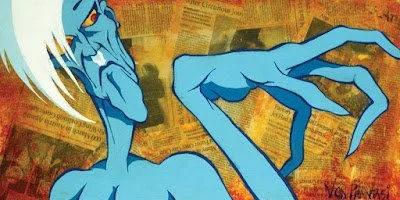
“Media Christ II” - 1994
"I had just gotten a degree in computer science, was proficient in 3 major programming languages, worked in animation as a multimedia producer, but still dreamed of making a living as an artist and would often have work hanging in local galleries. It was inevitable that these world's would collide eventually."
In this series, Woodward creates a grotesque, often angry character, the embodiment of the ugliness and rage he’d see in these forums.
It’s interesting to note that much of the imagery and emotion seen in these multimedia pieces is still, and perhaps more, relevant today. Is Woodward a prophet, able to see a bleak future for the online experience, full of harassment, doxxing, cyberbullying, and unprovoked fury? Or is it simply that nothing has really changed since the early days of net-based social interaction?
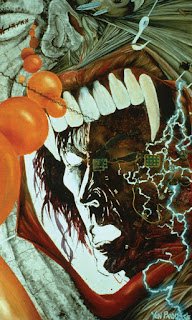
“Webshock” 1993
mixed media on 36” x 50” canvas.
The first painting in the series depicts a man being devoured by a mutilated, blinded humanoid.
The man being eaten is covered in circuit boards, and lightning seems to be emanating from his eye, made of a shard of mirror. Which embodies the internet, and which the user? Arguably, both characters in the painting represent both real life entities. The internet is made up of users, who feed information into the system, while devouring as much information as they can. Now, the Internet devours all of our time, and we take the time of others who could be interacting with the people around them. It’s a never-ending cycle, one that we commit to blindly, just as blind as Woodward shows the two figures.
"I wanted to create a visual representation of the potential dark nature of 'global community' as I saw it; a vision where the user and the collective consciousness are discernable, but just barely and with an obvious connective tissue. I was never happy with this piece."
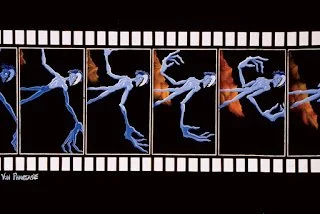
The next two paintings show the birth of Woodward’s version of the Internet troll.
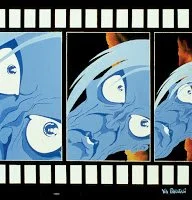
"I didn't realize it at the time, but what I wanted wasn't a visual representation of an experience, I wanted a character representation, that I could simply walk through a media storm in several different paintings"
The first painting shows the troll embracing the shadow that slowly engulfs him. All too often, internet arguments devolve into name-calling and cursing almost immediately. One user might encourage another to kill himself simply for expressing an opinion. It’s not uncommon. The anonymity of the internet encourages some users to give in to their id, their darker, baser instincts. The third painting shows an inquisitive nature in the troll. Still angry, the troll gets closer and closer to the camera, inspecting, judging, searching for signs weakness, ready to destroy your sense of self-worth with a few cruel remarks. This toxicity remains today. I’m reminded of the comics fans who attacked the female Marvel editors for posting a photo of themselves with milkshakes. Joy met with rage.
Later in the series, Woodward explores the ideas of anonymity and isolation, and the mob mentality, and conformity of thought that is prevalent online. "I started with the animation, probably because of my work as a multi-media producer, but eventually landed on written language as a tool for the series. I would use "be" as a verb followed with an adjective and paired it with a verb that used "be" as a prefix to create one imperative statement." One painting shows two trolls, identical, but separated by a maze of walls. One troll thinks, “Beware,” while the other thinks, “Be Anonymous.”
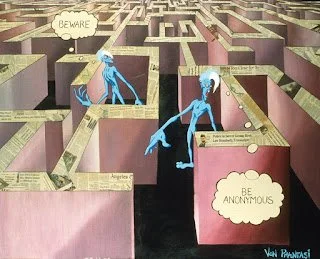
Anonymity is a recurring theme in this series. The internet affords certain levels of anonymity, which emboldens its users to act differently than they do in real life. A meek, generally quiet person can transform into a racist, screaming lunatic that curses out anybody who would dare disagree with them online. The walls in the piece are put in place by the users themselves. The wall can be a screen name, or the personality they take on when they interact with other users - anything that prevents others from knowing anything real about us. The web connects us, but we’re still apart. The next painting in the series shows the dangers of the mob mentality. A new user, intimidated by behavior of other users, may simply fall in line with everyone else’s line of thinking to avoid a digital tongue lashing - even if you might disagree with someone’s point in real life, you agree with them online. Perhaps you do this out of fear, or simply a desire to belong. Whatever the reason, it’s a sinister side-effect of online social interaction.
"It occurred to me that in this new world of interconnectivity, we would start viewing everything from a 'portal eye view", like looking out a window(or into a screen), but never really engaging in a meaningful way.; just staring out the window."
Living in an echo chamber is far easier than interacting with people of differing opinions. The trolls are painted identically, all in the same pose, throwing up an angry “Sieg Heil.” The background of this piece is fitting, the weekend market report from the financial section of a newspaper. If you can get everyone to think a certain way, you can control how they spend their money. As an example, trick a population into fearing a gas shortage, and they’ll start stockpiling it, which allows you to drive up the price. Trick people into fearing an entire race, and you can convince them that going to war is a good idea, which helps you sell weapons. Woodward drives the point home by adding the text “Be Placid. Belong.”
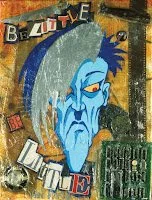
The final two pieces in the series focus on the unrelenting judgement experienced online, and fear.
One painting contains the text “Belittle. Be Little,” which implies that those who belittle others online are small, petty people.
This is something most users have certainly experienced, no? A small mistake, like a typo, can invalidate your entire argument to a troll. “Only an idiot would make such a mistake, so why should anyone trust what you say?” seems to be the thought process here. Woodward has attached a broken knife to the top of the painting, implying that insults are the ineffective weapons of the troll. Though feelings may get hurt, it’s the troll who is truly frightened. They seek the same validation and acceptance as anyone else, despite adopting such a repellant persona. The final piece contains the text “Be Paranoid. Behave.”
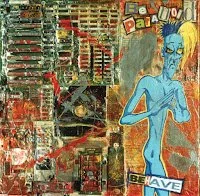
The troll is shown in a contemplative pose, as if he’s calculating his next move very carefully. Perhaps he’s had to assume that everyone else on the internet is a troll, too, and so he has to be perfect.
He composes his arguments carefully, but he’s ready with a nasty remark for anyone who would contradict him. Fear of the others, fear of looking foolish, fear of reaping exactly what he’s sowed, keeps him mean and angry. A self-fulfilling prophecy.
Woodward revisits these themes with a final piece completed in 2017, 20 years after the original series. We see the familiar troll in a new light. Woodward depicts the troll taking a selfie with a smartphone. The screen is cracked. The troll narrows his good eye seductively, as if trying to conceal the past 20 years of ugliness. Now users have a variety of personae: their real world self, their forum self, and the self they show their friends on social media. On social media, I’m having the time of my life, a drink in hand, a come hither smile, and aren’t you so jealous of all the fun I’m constantly having? In the forums, I’m an expert on the subject, infallible, and I will crush anybody who opposes me with a racist, misogynist, transphobic and/or homophobic remark and a death threat - fear me or I’ll troll you into oblivion. In the real world, I’m you friendly neighborhood barista: I draw you in with my casual charm, and I make your latte just the way you like it - maybe someday you’ll work up the nerve to ask my number. Which one is the real me?
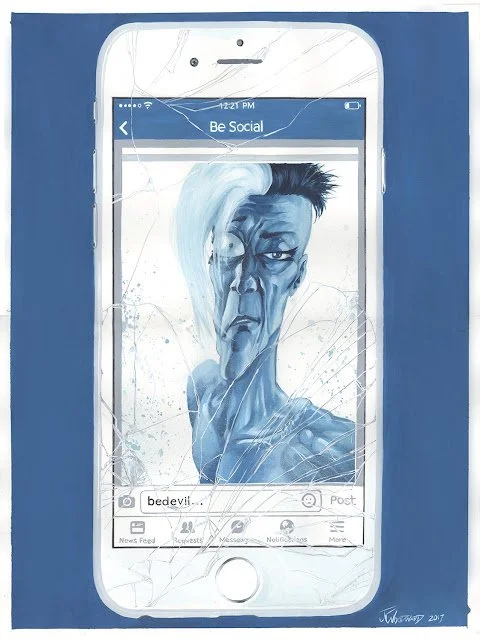
The differences in style between the 2017 piece and the 1997 pieces are vast. In ‘97, Woodward used assemblage to create a techno-atmosphere for each piece. Bits of circuit boards, floppy discs, cables, wires, and other found objects help set the scene, just as much as Woodward’s painted backgrounds. There’s something very raw and reactive in these pieces - an anger beyond that which we see in the troll. The 2017 piece shows a great deal of refinement and elegance. Woodward has moved on from acrylics, oils, watercolour, gesso, and found objects on canvas to the medium where he’s made his home, gouache on hot pressed cotton. We still recognize the troll, but there’s a softer eye placed on him. There’s a sleek simplicity at first glance, and it thinly veils the deeper meaning behind the piece. Not only does the subject matter convey meaning, but the style itself. The beauty of Woodward’s contemporarialized lines, shadows and palette are almost superficial, hiding the ugliness of the painting’s meaning. The troll tries to hide his own ugliness within the selfie. However, given the context we have of the Troll’s past, we know this beauty is false, a ploy to lure you in and disarm you before he shreds your self-worth. "Revisiting this series was strange for me, not only because the internet has changed so much, but also because it had changed so little. In the 2017 piece, I focused on the difference. There was a vanity added that came with the prevalence of social media and so many people becoming unwitting PR experts , working for themselves. We now present to the world what we want people to see and not who we are. There's still the nastiness to be sure, but there's also a lot of energy being spent to build a facade to hide it behind. that's what I was trying to express here."
The image Woodward creates of online ugliness is dire. For all the benefits of the internet, the world’s collective knowledge in the palm of your hand and the ability to stay in touch with anyone at any time, there are negatives, too, like the ability to spread misinformation on a global scale, to manipulate thought, to crush the spirit of someone with a casual cruel remark. Woodward glimpsed this negativity 20 years ago, as he tried to connect to strangers who shared his interests. Today, all that’s really changed is the volume of users. The negativity was always there, lurking in the background, like a troll in the shadow of a bridge. Woodward saw it for what it was, and gave it form.
more details on the “Media Christ” series in this websites gallery: https://www.theartofjkwoodward.com/portfolio-2/new-portfolio-item